
The Executive Director
Adapted from Season 2 Episode 11
Hey guys, welcome back. I wanted to follow up on the last episode by talking a little bit more about the executive director staff position. I promise I won’t make this one as long as the last episode. Like I said, there’s a lot to talk about here.
This staff position—executive director—is a nonprofit term. In donor-funded nonprofits, like homeless shelters or animal shelters, where the people being served are not paying for the service, the executive director and the board usually have an additional layer of responsibility around fundraising, donor cultivation, and grant writing.
When I was researching nonprofit job roles and board roles, I found a lot of descriptions that focused heavily on those fundraising aspects. But in a fee-for-service nonprofit, especially one that is close to or 100% tuition-funded, tuition is the fee. The people being served are paying for the service.
If you structure your budget so that you don’t rely heavily on donations or grants—which I generally recommend for most hybrid school models—then a lot of that traditional nonprofit fundraising language doesn’t fully apply and a big part of the job descriptions you will find online might seem less relevant.
Now, there are exceptions. If your program is specifically designed to serve families who cannot pay tuition—such as programs for underserved —then fundraising and grants are essential, and that’s a different model.
But for many hybrid schools, tuition funding is the primary revenue source. So founders often look at nonprofit job descriptions and think, Well, that doesn’t really apply to us. What are we supposed to be doing? What is the board supposed to be doing?
So today, I want to set fundraising aside and talk specifically about the actual job description of the executive director.
The term executive director essentially means the person responsible, as a staff member, for executing the mission—making sure it actually happens.
I often think of this role as the bridge between the board, which governs and stewards the mission, and the day-to-day operations that make the mission happen on the ground.
In a school setting, this can feel confusing. You might wonder:
Is this a principal?
A head of school?
A head teacher?
That’s a fair question, and that’s why it’s important to understand what a nonprofit executive director does structurally—especially in relation to the board and to staff.
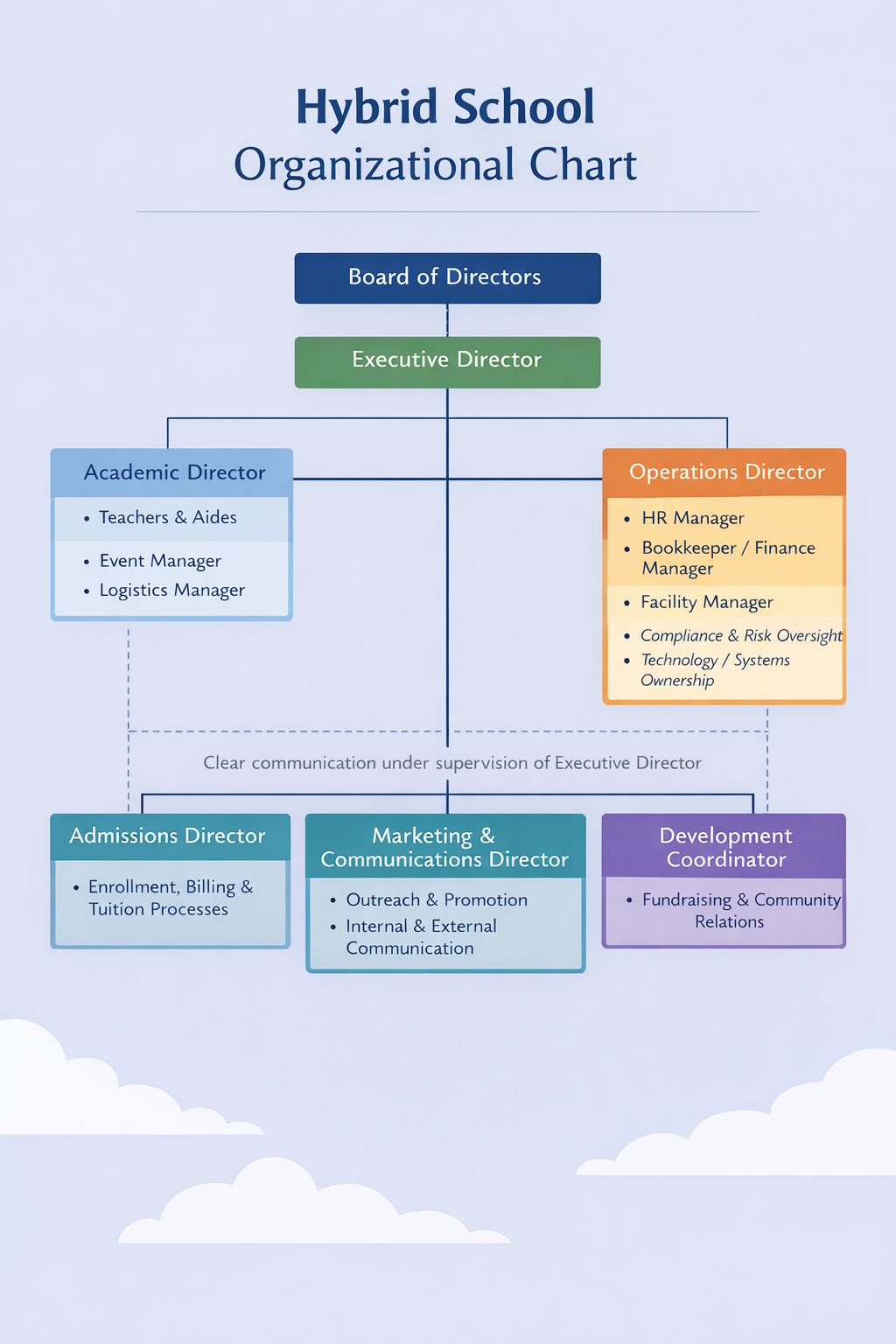
Hybrid School Organizational Chart
This image may help you understand how this might play out in a moderate-sized school format (moderate because a very small program will likely have the ED also be the Academic Director and Operations Director also, if not Admissions, Marketing, and Development! But remember, NAME all the hats!
I’m going to briefly summarize how BoardSource, a well-known nonprofit governance resource, describes the division of responsibilities between the board chair (or board president) and the executive director.
The board chair—who I usually call the board president—is the lead governance volunteer. They run board meetings and oversee governance. The executive director is the lead staff member overseeing operations.
I generally do not recommend that the executive director also serve as board president. That overlap creates confusion between governance and operations. Separating the two roles helps everyone understand their responsibilities more clearly.
BoardSource outlines several key organizational areas:
Policy and planning
Budget and finances
Fundraising and development
Board meetings and committees
Board recruitment and development
Staff oversight and compensation
Public relations and communication
That sounds like a lot, so let me walk through it briefly.
Policy and Planning
Both the board and the executive director share responsibility for strategic planning, mission impact, and organizational sustainability—but their roles look different.
The executive director understands the mission and provides administrative leadership. They engage in planning with the board, but they are also responsible for implementing those plans.
They gather information, evaluate programs, and report back to the board so the board can assess whether the organization is accomplishing its mission effectively.
Once the board sets priorities or approves a strategic plan, the executive director takes that direction and translates it into staffing decisions, program changes, or growth strategies.
This is easier to visualize in larger programs—where you might have multiple campuses or multiple program days. Supervisors may oversee teachers, and the executive director oversees those supervisors and reports to the board.
The key distinction is that the executive director is responsible for mission execution across the entire organization, not just managing one team.
Budget and Finances
Both the board and the executive director are stewards of the organization’s finances.
The executive director typically prepares the budget. They know what’s happening on the ground—staffing needs, rent increases, program costs, and growth projections. They make resource-allocation decisions and propose a budget to the board.
The board provides oversight—asking questions, ensuring transparency, approving the budget, and making sure proper checks and balances are in place.
Once approved, the executive director ensures that financial processes are followed and any adjustments are communicated appropriately.
Board Meetings and Committees
The board president leads board meetings—calling meetings to order, managing agendas, ensuring participation, and keeping meetings on track.
The executive director supports this process by providing agenda items, reports, and necessary information. They typically attend board meetings but should not lead them or vote, except in rare cases.
Committee work is board work. The board president oversees committee structure and appoints committee chairs. The executive director may participate in committees where operational expertise is needed—such as finance—but their role is to provide information and implementation support.
Board Recruitment and Development
Board recruitment, assessment, and development are primarily the responsibility of the board president and board leadership.
The executive director may suggest potential board members due to their community connections, but it should not be their sole responsibility to build or maintain the board.
The executive director’s role is to ensure that board members have the information they need to govern effectively and that communication remains strong.
Staff Oversight and Compensation
Staff oversight is primarily the executive director’s responsibility.
The board’s role is high-level oversight—ensuring sustainability, fair compensation, and organizational health. The board should not be managing staff, setting individual salaries, or evaluating employees.
The executive director handles hiring, supervision, evaluations, and determining how roles fit into the budget and organizational structure.
The board evaluates the executive director, not the staff.
Oversight Without Micromanagement
The executive director must be capable of overseeing budgets, compliance, safety planning, staffing, and program evaluation.
The board ensures accountability without micromanaging—making sure critical systems like safety plans, financial controls, and escalation policies exist and are functioning.
This requires trust, communication, and clear role distinctions.
Connecting Back to Founder Burnout
Many founders function as de facto executive directors in the early years—often without a title, job description, or compensation clarity.
One of the earliest responsibilities of a trained board should be to formally appoint an executive director, define the role, set compensation, and establish accountability.
It doesn’t have to be perfect from the start. The structure can evolve. But clarity builds trust, sustainability, and support—and helps prevent burnout.
Clear distinctions between board governance and executive leadership are essential for long-term health.
📍 Thanks so much for listening today. Don’t forget to subscribe, and be sure to check out the resources I’m developing at startahybridschool.com.
Send me an email anytime—I’d love to hear from you.
Until next time
